
My Week In Film: December 1, 2025
Linklater gives us two, Lanthimos fails at one
Not too many in the diary this week because I watched a lot of stuff we’ll be discussing on the Riviera Rats podcast later this month that I’ll save for a future post (I don’t want my co-host Greg to know my thoughts in advance!)
I caught a few new releases at the cinema, including finally catching up with Richard Linklater’s bountiful output this year. Ratings are out of 5.

Nouvelle Vague
Richard Linklater, 2025
Rating: BBBB.5
Cast: Guillaume Marbeck, Zoey Deutch, Aubry Dullin, Bruno Dreyfürst, Benjamin Clery, Matthieu Penchinat, Pauline Belle, Blaise Pettebone, Benoît Bouthors, Paolo Luka Noé, Adrien Rouyard, Jade Phan-Gia, Jodie Ruth-Forest, Antoine Besson, Franck Cicurel, Roxane Rivière, Jean-Jacques Le Vessier, Côme Thieulin, Laurent Mothe, Jonas Marmy, Niko Ravel,
Linklater made two films exploring the creation of groundbreaking twentieth century art in 2025, debuting Blue Moon at the Berlin Film Festival and following it with, for me, the much more superior of the two at Cannes. The festival on the Riviera is a setting at the start of this film, where we meet the reviewers for the Cahiers du Cinema who have begun shifting into careers as filmmakers themselves, their renegade style declared a “new wave” in cinema storytelling that starts with Louis Malle’s Elevator To The Gallows and achieves legitimacy with the Cannes prize for Francois Truffaut’s The 400 Blows (only a year after he’d been banned from the festival for being the “enfant terrible” of the press). Jean-Luc Godard watches in frustration as his friends and colleagues achieve instant fame, feeling the clock ticking as he struggles to make his own debut but with little forward movement. A lengthy script he has written is given the axe by his producer, so Godard decides to try and make something much smaller, using an outline his buddy Truffaut gives him, the tale of a petty thief on the lam and the girl he gets mixed up with that pays tribute to the Poverty Row gangster movies that they have been watching on a loop at the Cinémathèque Française. The script is finalized (including writing sessions on the platform of the Paris metro), and the cast is assembled, the male lead given to a young newcomer with boxing credentials named Jean-Paul Belmondo, and the female lead to an American movie star looking to pivot in her stalled career named Jean Seberg (Linklater has cast newcomers to play all the newcomers with the exception of the established Zoey Deutch as Seberg).
Day one of shooting begins and Godard, who has not yet proven himself a genius auteur, is instantly a confounding mystery to everyone on the crew, shooting quickly and unconventionally, sometimes taking whole days off and giving vague and unsure instructions to his actors. His producer Georges de Beauregard is ready to commit violence and Seberg is not afraid to show her disapproval of what she feels is a circus of a film shoot, but Godard never flinches; carrying on in his anarchist manner until filming ends, he then brings his tactics to the editing room, where he more or less invents (or at least popularizes) the jump cut.
The reason Linklater’s movie about this movie has been made, however, is not just to set us up for the results, which for anyone who doesn’t already know it is Breathless (À bout de souffle), one of the most influential films of all time and the film that would come to define the Nouvelle Vague despite being made so long after the hits that established the movement. Linklater is telling us, in a roundabout and never overly preachy way, that for artists to make a difference they can’t be easy people, and that in particular the industrial, commercial machine that is applied to filmmaking is not always a direct line to making the films that capture an audience’s imagination. The right of an artist to not be a good citizen is a tricky subject to play with now, following the #MeToo movement and the downfall of a number of famous filmmakers in the Art Vs. Artist debate one must put parameters on this idea that we need to let people break the rules in order to make a difference in culture, but thankfully Linklater has, to my knowledge, chosen a subject that doesn’t risk these theoretical extremes. In execution, what works so beautifully here is that Linklater pays tribute to Breathless by making his film in its style and rhythm, shooting in the original’s aspect ratio, on grainy black and white stock, with dialogue entirely spoken in French. Guillaume Marbeck is wonderful as Godard, bringing to life the auteur’s irreverent charm (in fact he makes him more charming than he ever was in person). Deutch is a marvel as Seberg, commanding the camera every time she’s on screen and doing justice to a performer who was never properly respected for her achievements during her short life. It will likely be overlooked by the time we are deep in awards season, but Deutch gives one of my favourite performances this year, there’s something exciting about her unflinching determination that jumps off the screen every time the camera is turned on her.
Blue Moon
Richard Linklater, 2025
Rating: BB.5
Cast: Ethan Hawke, Margaret Qualley, Bobby Cannavale, Andrew Scott, Jonah Lees, Simon Delaney, Cillian Sullivan, Patrick Kennedy, John Doran, Anne Brogan, David Rawle
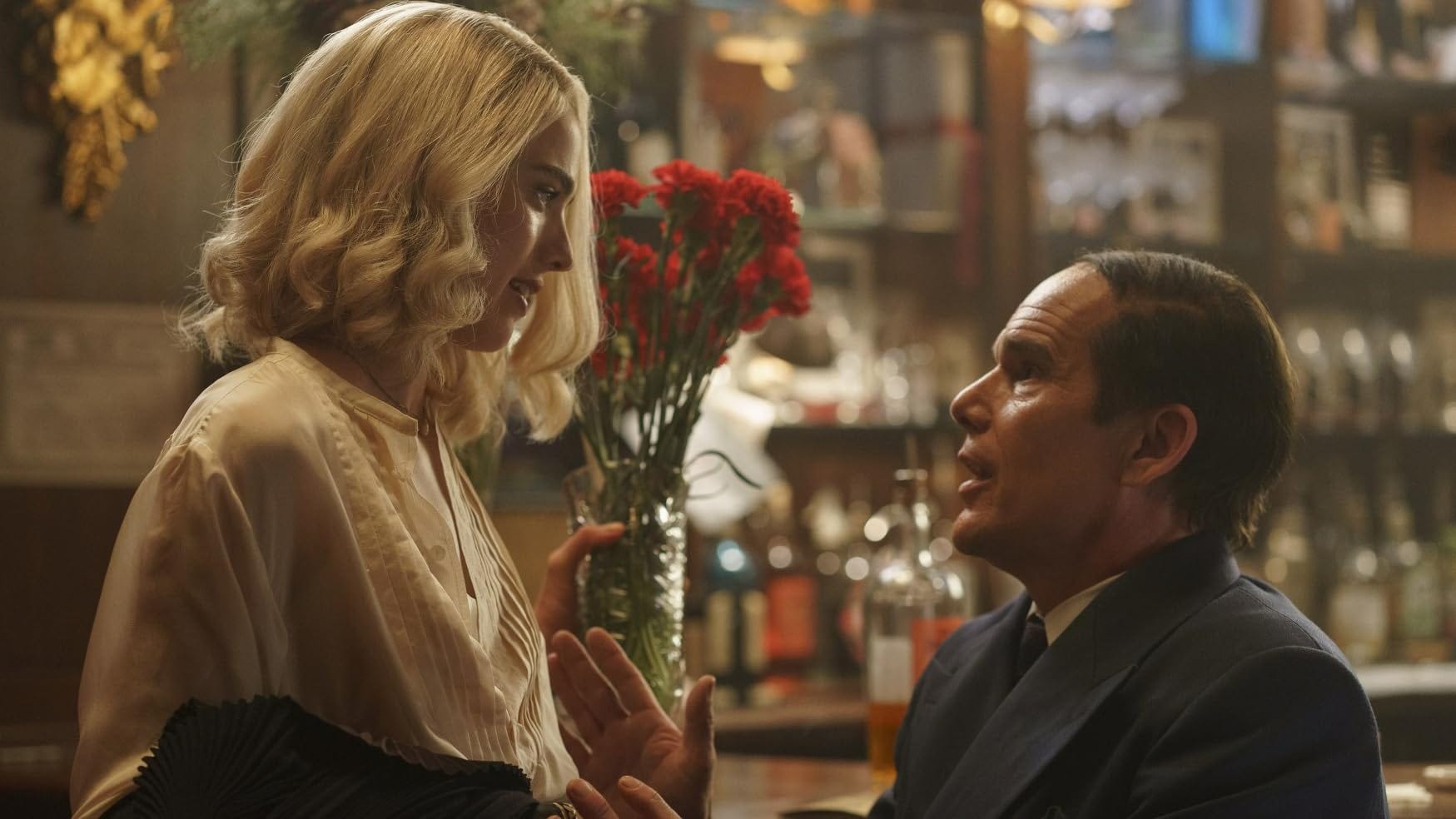
It’s March 31, 1943, the war is still raging in faraway places but New York has its own noise to distract it from so harsh a reality. A new musical, Oklahoma! has just opened, and the town is abuzz over a breakthrough in the artform, having never before seen a full-length show that set opera-style recitative at the lower pitch of popular music, woven into a play’s narrative. Not everyone is won over by the musical, however, as songwriter Lorenz Hart (Ethan Hawke) excuses himself during the closing number to head to Sardi’s where Oklahoma!’s cast and crew will soon be celebrating their opening night victory. Setting up at the bar with the tough-talking but friendly bartender (Bobby Cannavale) and reminding him of his promise to give up drinking, Hart begins to wax poetic on the success of Oklahoma! but, simultaneously, makes wisecracks about its corny, downhome charm, and the reason for his ambivalence is quickly sniffed out: Oklahoma! is composed by Richard Rodgers, with whom Hart wrote many a musical before his partner switched to lyricist Oscar Hammerstein II, with whom we know he will make everlasting history in the years to come.
Hart is in his early forties but his personal issues with drinking make him seem so much older, it’s clear that his genius for writing lyrics (which to his chagrin is best known for this film’s title song) hasn’t saved his reputation, and everyone around him is an opportunity to soothe his ego despite his trying to convince them that he doesn’t need it. The delivery boy who keeps bringing flowers meant for Rodgers gets a great deal of wolfish attention from our hero (and invitations to an after-hours party that we’re pretty sure won’t go very well), but despite knowing that he’s gay, the rest of the room (which includes author E.B. White) is treated to a lengthy narrative that Hart spins about his failed assignation with a beautiful young starlet named Elizabeth Weiland (Margaret Qualley) and his plan to seal the deal with her when she arrives at the party.
Rodgers arrives (played by Andrew Scott) and he and Hart set fire to the screen, with Hart pretending not to be desperate to get back with his old partner while Rodgers is caught between pitying his old friend and wanting to get away from him. For all that he’s proud of the work they’ve accomplished, the stiff-backed, bloodlessly professional Rodgers doesn’t want to go back to a working process that involves waiting at his piano while his alcoholic friend has gone off to drink away his sorrows. He does present him an olive branch, however, in offering to reunite with Hart briefly to touch up a past hit, A Connecticut Yankee, and restage it in an updated format, but Hart insists they work on a new project, a musical about Marco Polo, that Rodgers has zero interest in doing.
Weiland finally gets to the party and pulls our thwarted hero aside for the settling of their own plans, and because Robert Kaplow’s screenplay is created from letters written between Hart and Weiland, this plot is treated as the central focus of this very theatrical-feeling film, and the choice is a baffling one. Every time Hart, performed with exceptional finesse by Hawke in one of his most complex and interesting performances, talks with or about his collaborator turned rival Rodgers, the film is alive with conflict and a darkly humorous charm. When he switches to talking about Weiland it’s impossible to stay awake, and their lengthy scene together, in which she lets him know that he wants her for the wrong reasons, is, despite the talent of both actors involved, impossibly dull and lacking in drama. It’s when Hawke and Scott share the screen that the film works best, and it’s very strange that Linklater allows it to be a subplot, then spends a good deal of time embarrassing us with Forrest Gump-style origin stories that we don’t need involving Oscar Hammerstein II (played by Simon Delaney) introducing us to his young protege (Stephen Sondheim, played by Cillian Sullivan), Hart giving White the idea for Stuart Little and, very randomly, meeting George Roy Hill and inspiring him to make buddy movies (The Sting and Butch Cassidy and the Sundance Kid, in case you didn’t know).
Shot in Dublin almost entirely on one set that effectively recreates the Sardi’s of yore (and makes it much bigger than it is in reality), it should be a pleasure to watch this fantastic cast in period costumes holding court for two hours, and it should be far more exciting to see Hawke be given the opportunity to break free of his usual aging slacker (no pun intended) routine. Instead it’s a film undone by the weight of its downsides, beginning in a very witty and sharp mode, highlighted by its most exciting exchanges before getting confused about its central relationship.
Bugonia
Yorgos Lanthimos, 2025
Rating: BB.5
Cast: Emma Stone, Jesse Plemons, Aidan Delbis, Stavros Halkias, Alicia Silverstone
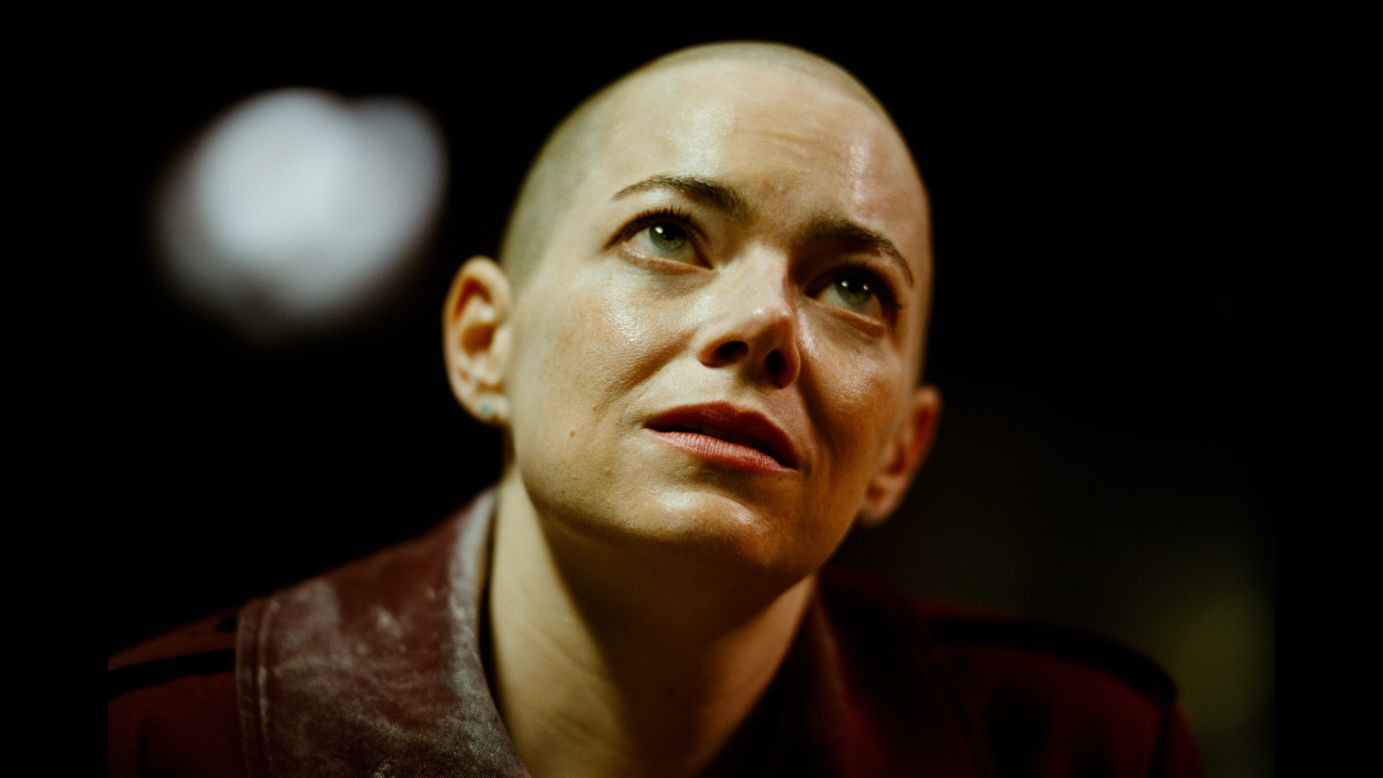
The CEO of a pharmaceutical corporation named Michelle Fuller (Emma Stone) is abducted by Teddy and Don, two conspiracy theorists (Jesse Plemons, Aidan Delbis) who lock her in their basement and accuse her of being an alien invader who is part of a conspiracy to conquer Earth for her own nefarious purposes. Finding herself tied to a cot, her head shaved and her body covered in lotion that her captors believe will stop her communicating a distress signal to her fellow “Andromedans”, Michelle tries every version of the negotiation tactics that have helped her conquer the boardroom on these two truly disturbed individuals, but to no avail. Teddy and Don, it turns out, are connected with Michelle’s company and blame her for the illness that one of their projects brought on their mother (Alicia Silverstone), a situation involving clinical trials (and errors) that have driven them to the madness that they are currently enacting on their captive.
Lanthimos took over as director after Jang Joon-hwan stepped down from remaking his own 2003 science-fiction film Save The Green Planet, the script having already switched the gender of the kidnap victim and one of the captors and doing a rather half-hearted attempt to connect the plot to today’s political landscape. Teddy and Don are meant to embody the vast distance between what America’s powerful corporations know about the average citizen and the reality of their lives, the future of the country hooked up to a life support machine that probably can’t save a hopeless situation. I appreciate that the filmmakers keep Jang’s audacious ending from the original film, but, while remembering that the original isn’t even the best that the New Korean Cinema has to offer, Lanthimos fails to generate much more than a passable remake. Plemmons and Delbis give flat performances that look that much worse thanks to Stone’s running circles around them with just her facial expressions, but keeping her character confined, for the most part, in one place means that we frequently cut away from her to characters whose madness isn’t particularly interesting. Scenes of dinners and beekeeping and a subplot involving an annoying local cop, a character that simply never works, are not clever enough to show Lanthimos at his most savage; it’s not a film I’d label a total failure, but there’s no denying that it is woefully underwhelming.