
The Films of Joan Crawford: Part 2
1940-1949: The Reinvention Tour
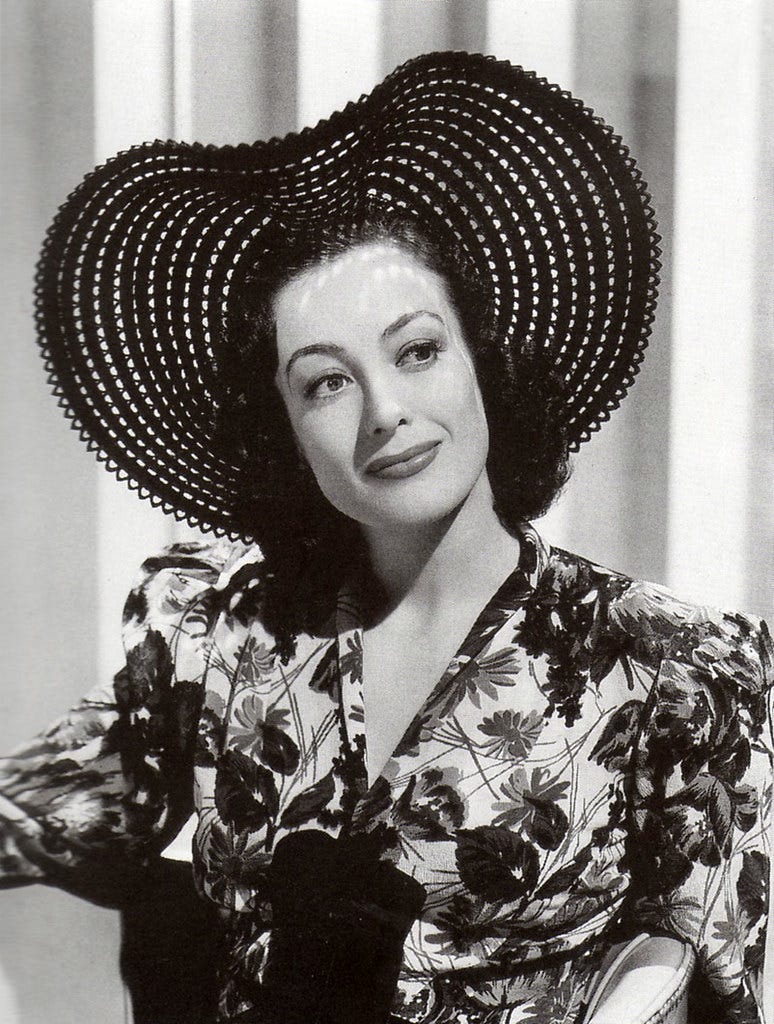
Crawford was labeled “box-office poison” by the end of the 1930s (a term I have myself never seen applied to a male actor), but as she would prove many times in the future, she was never going to let the industry’s attitude towards aging women or its desire for a high turnover of new faces stop her from proving her value. The early forties was a slump for her movie career, MGM leaving her to languish in forgettable projects for the remainder of a contract that they didn’t plan to renew. Taking the matter in her own hands, Crawford cut ties with the studio and started again, at the ripe old age of 40, at Warner Bros, where her first project not only put her back on top of the game but earned her an Academy Award for a performance that would come to define her.
Strange Cargo
Frank Borzage, 1940
Rating: BB.5
Cast: Clark Gable, Joan Crawford, Ian Hunter, Peter Lorre, Paul Lukas, Albert Dekker, J. Edward Bromberg, Eduardo Ciannelli, John Arledge, Frederick Worlock, Bernard Nedell, Victor Varconi, Paul Fix
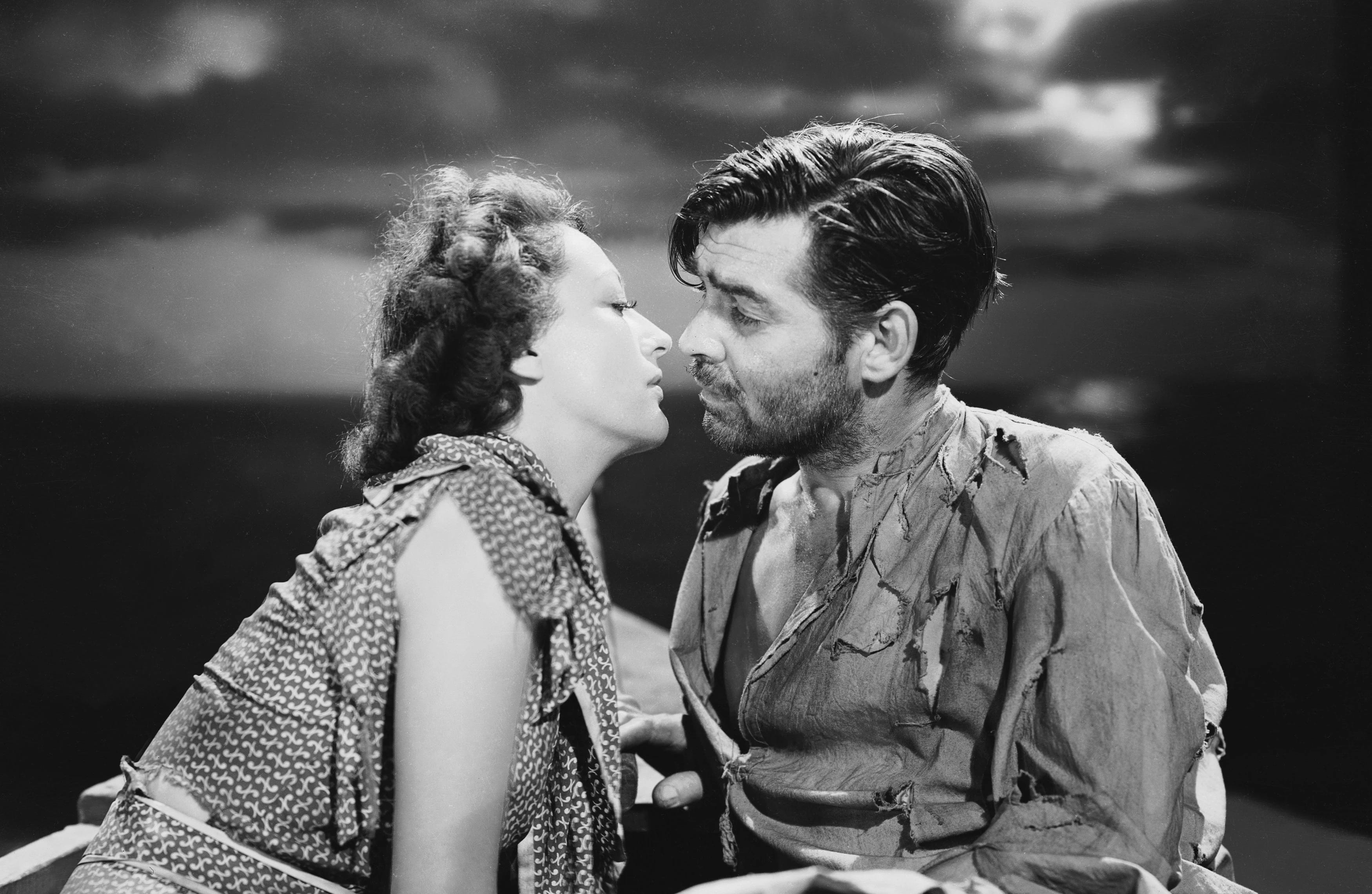
Clark Gable is a prisoner on the penal colony of Guyana whose sentence is not being shortened by his constant escape attempts. Joan Crawford plays a tough-talking dame who hangs around the pier smoking and waiting (and we all know what that means), and after she catches his eye, Gable is inspired to take another stab at breaking out. He does so successfully, but after he is caught in her quarters they are both punished by the law, he to return to custody and she expelled from the colony for having fraternized with a prisoner. Told she must pay her own way out, Crawford is stuck having to accept the company of a scoundrel who traps her in his shack. Thankfully, Gable stops there on his next escape attempt, taking her along with himself and the group of men who are making their way through to the jungle to a rendezvous with a ship that will take them away from this place. In their company is a strangely calm and wise character (Ian Hunter) who seems to be able to predict the weather and see inside men’s hearts, and as their journey progresses, the stakes rise and loyalties shift, he always seems to be there to help characters put things in perspective. What at first began as a jungle adventure eventually appears to be something intent on quieting the fury of Gable’s soul, an odd combination of escapist exploitation and moral lecturing that never quite finds its landing ground anywhere: there is little satisfaction in either the turns of the plot, the relationships between the characters or the film’s idea of fate and justice. Gable delivers mouthfuls of dialogue that he never seems to have actually read before memorizing, his realizations towards the end are hollow and wearisome. Crawford’s attempt at a Barbara Stanwyck-like wiseacre speaking voice is never convincing, at this point she had worked so hard to smooth herself into such an elegant and refined icon on screen that trying to invoke low origins come across as disingenuous. The images are beautiful, but you’re better off going to John Ford’s tropical island in The Hurricane than this weighty and unrewarding adventure.
Susan and God
George Cukor, 1940
Rating: BB.5
Cast: Joan Crawford, Fredric March, Ruth Hussey, John Carroll, Rita Hayworth, Nigel Bruce, Bruce Cabot, Rose Hobart, Constance Collier, Rita Quigley, Gloria DeHaven, Richard Crane, Norma Mitchell, Marjorie Main, Aldrich Bowker
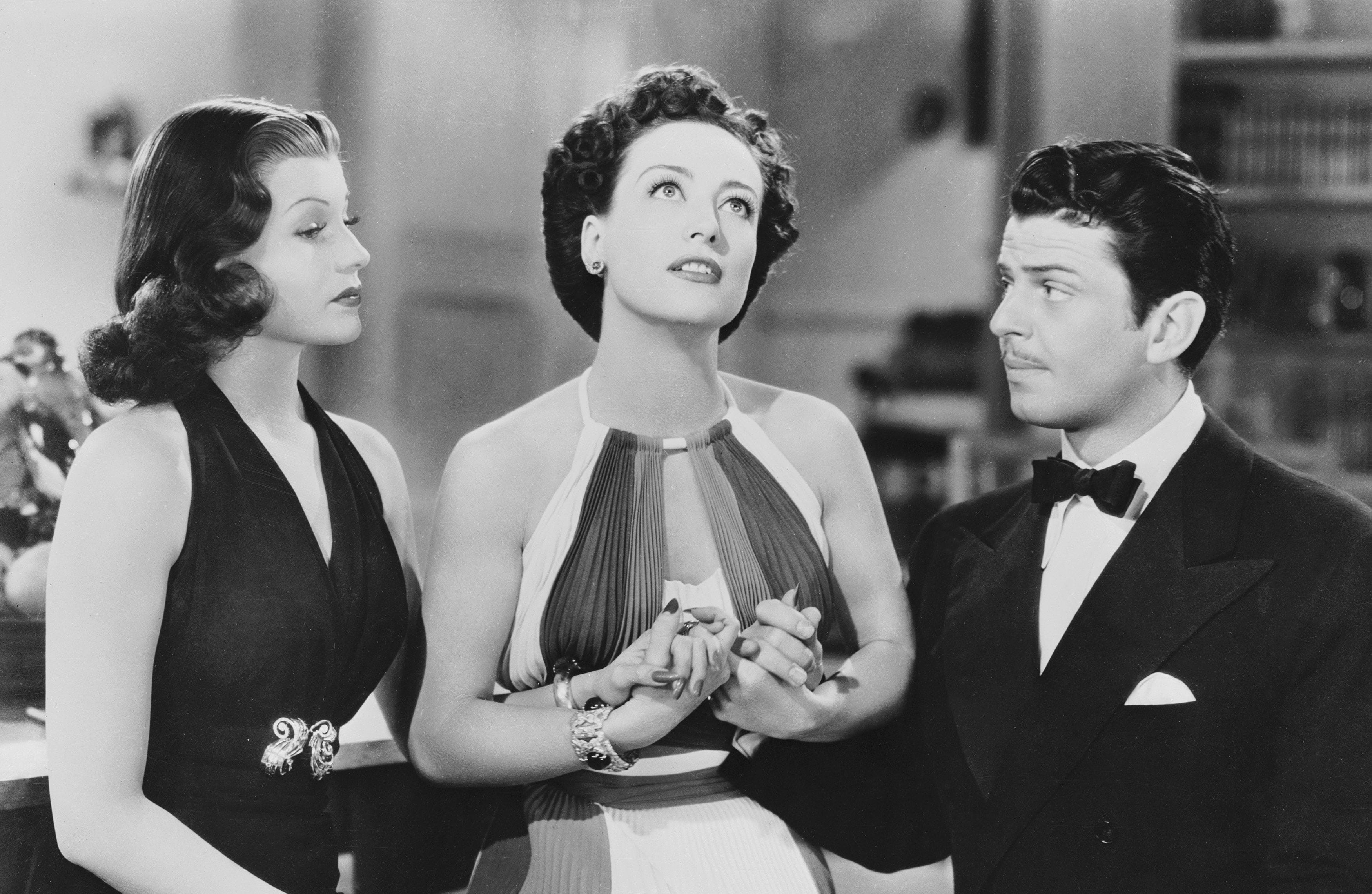
Positively weird comedy about a socialite who finds God. Susan combats the weak habits of her alcoholic husband (Fredric March) by taking refuge in religion, much to the chagrin of her party animal friends who’d rather not be imposed upon by this pushy woman. Crawford is terrific in the role, but the film is not all that memorable.
A Woman’s Face
George Cukor, 1941
Rating: BBBB
Cast: Joan Crawford, Melvyn Douglas, Conrad Veidt, Osa Massen, Reginald Owen, Albert Bassermann, Marjorie Main, Donald Meek, Connie Gilchrist, Richard Nichols, Charles Quigley, Gwili Andre, Clifford Brooke, George Zucco, Henry Kolker, Robert Warwick, Gilbert Emery, Henry Daniell, Sarah Padden, William Farnum
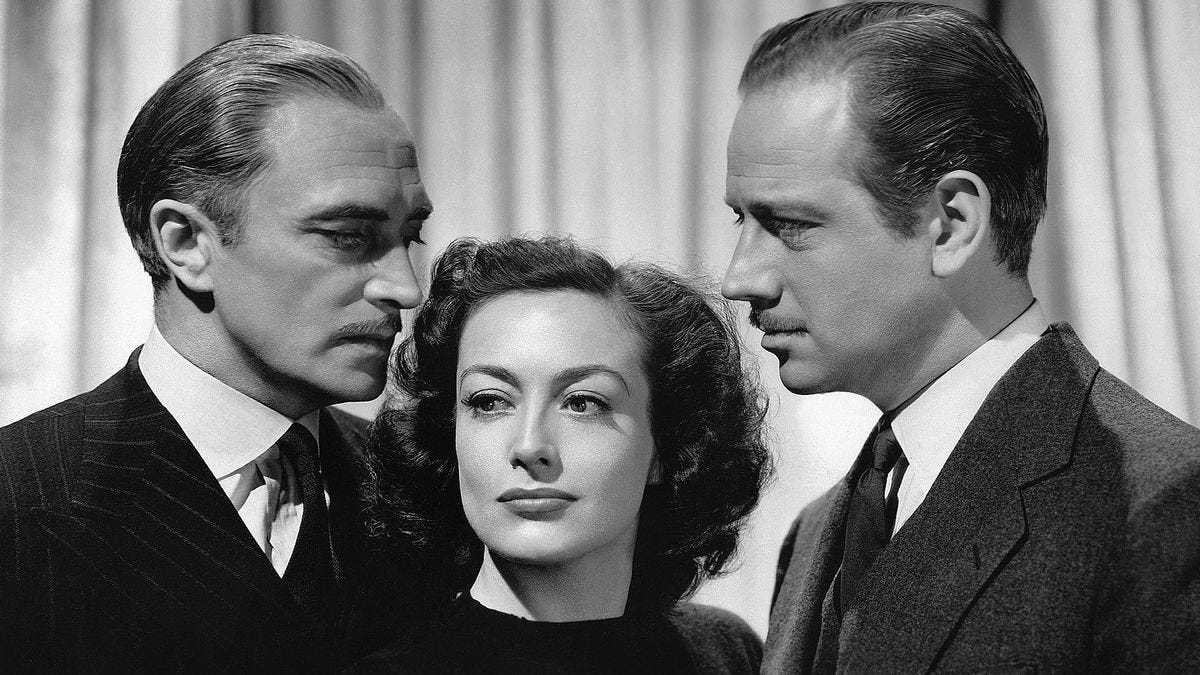
Crawford gives one of her most emotionally affecting performances in this excellent remake of the 1938 Ingrid Bergman film made in Sweden three years earlier. A court case has Crawford on the stand investigating her for murder and the witnesses come in, one after the other, giving testimony that flashes us back to her deeply disturbing past. She is a woman whose face was badly scarred in a fire as a child and spends her adult life in the shadows, taking revenge out on humanity by partaking in blackmailing schemes with a band of fellow thieves. When one of her victims turns out to be the wife of a talented plastic surgeon (Melvyn Douglas), he performs an operation on her that restores her to perfect beauty and it changes her outlook on life, but not her life itself. She’s still paired with the shady Conrad Veidt, who wants to use her new face to his advantage by getting her to take the job of governess to his four year old nephew, a child who stands between him and the inheritance of his uncle’s vast fortune. Crawford goes and lives at the old man’s country estate but soon finds herself at a challenging spiritual crossroads: can she escape her past, or is the scarring still there on the inside even if no one can see it on her face? Issues of image and character and the idea of people becoming how they are treated are folded intelligently into the dramatic structure of a compelling and entertaining film, one that provides the thrill of a breathtaking chase in its climax but also forces you to think about its deeper themes. It helps that Crawford gives the character a convincing sense of moral exhaustion, she plays with a resonance unlike her fiery melodramatic roles and is thoroughly convincing as someone who has been worn down so much by people’s rude stares and intimate questions that she has no spirit left in her except weary hatred (Cukor’s trick, it is said, was to get her to recite multiplication tables until she was exhausted before turning the cameras on). This is the director and his star working at the top of their games, with supporting characters Bassermann, Veidt, Douglas, Marjorie Main and Connie Gilchrist delivering superb performances in support.
When Ladies Meet (Robert Z. Leonard, 1941)
Reunion In France (Jules Dassin, 1942)
They All Kissed The Bride (Alexander Hall, 1942)
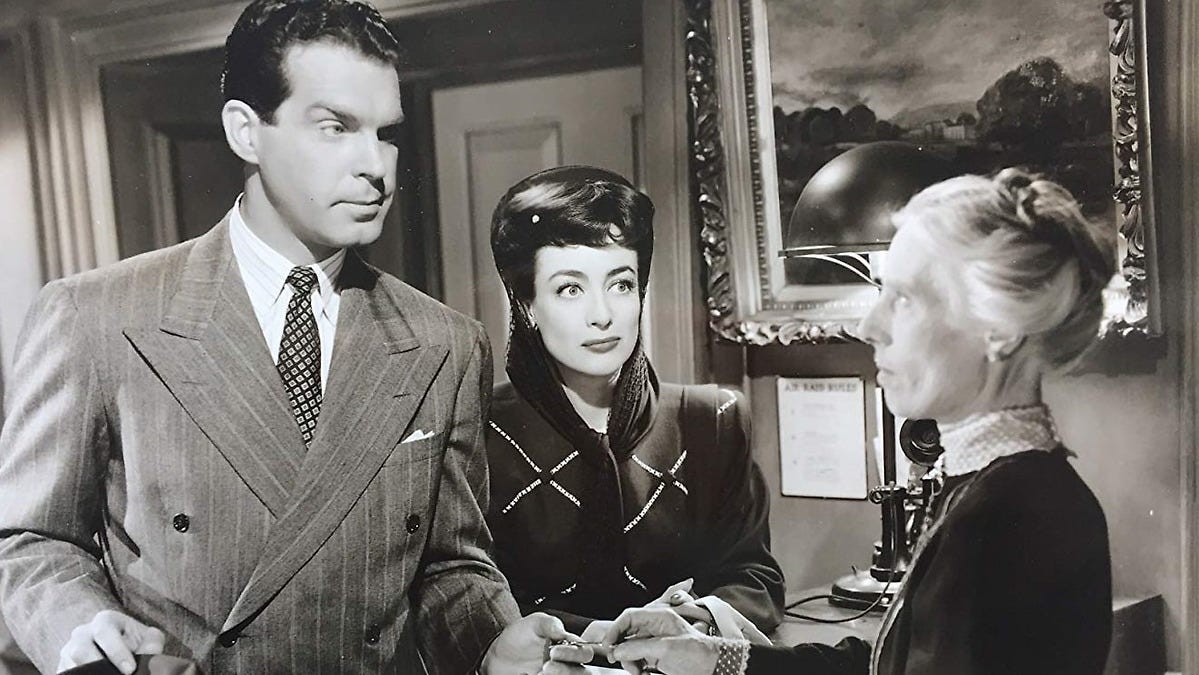
Above Suspicion
Richard Thorpe, 1943
Rating: BBBB
Cast: Joan Crawford, Fred MacMurray, Conrad Veidt, Basil Rathbone, Reginald Owen, Richard Ainley, Cecil Cunningham, Ann Shoemaker, Sara Haden, Felix Bressart, Bruce Lester, Johanna Hofer, Lotte Palfi-Andor, Lisa Golm, Ludwig Stossel
It begins on the wedding day of an American couple in England, Fred MacMurray is a professor at Oxford who has just walked down the aisle with Joan Crawford and they are zipping off towards their continental honeymoon. MacMurray’s old friend from the foreign office catches up with them in Dover, just as they’re getting into bed on their wedding night, and asks a huge favour of them: since they’re going across the channel on their trip, couldn’t they please help him locate a missing agent? He could send one of his own but he feels like a honeymooning couple would be so much more inconspicuous. MacMurray, who is deeply annoyed considering he was just about to get laid, reluctantly agrees, while Crawford, whose head is suddenly filled with the clichés of adventurous spy movies, can’t wait to get started, eager to put together clues and disguises. They head to Paris, then to Germany and Austria following coded messages and rendezvousing with their contacts, picking up Conrad Veidt (in his final film, he died before its release) and Basil Rathbone along the way; with both of the most famous shady character actors in the cast, it’s not possible that they’re both bad, so who knows who to trust? The game this couple is playing gets more serious as the stakes rise and eventually they are actually in danger of losing their lives, but the importance of doing their part against the threat of Nazi power is too great to abandon now. The delights are many in this highly satisfying caper, it doesn’t overdo its plot twists so it comes off as more than just a gimmicky thriller, taking its time to enjoy the stars’ genuine chemistry and the things they witness in a series of increasingly unusual circumstances. The sense of topography is less impressive, it looks more like visiting various countries in a theme park rather than actually going there, but the artificiality isn’t distracting and contributes to the fun. This was Crawford’s last film with MGM before she bought out her own contract and resurrected her flagging career with Mildred Pierce two years later, and the decision makes sense; she looks great and gives the movie a great deal of exciting energy, but the effort she is putting into keeping her face and image flawless have given her a steely exterior that makes her emotionally remote as a romantic heroine, and her desire to play the more grounded roles that her colleagues Bette Davis and Barbara Stanwyck were getting is much more suited to the image she was cultivating at the time. Classy, smart and adventurous, this is up there with Night Train To Munich as exciting morale-boosting spy thrillers made before the end of the war.
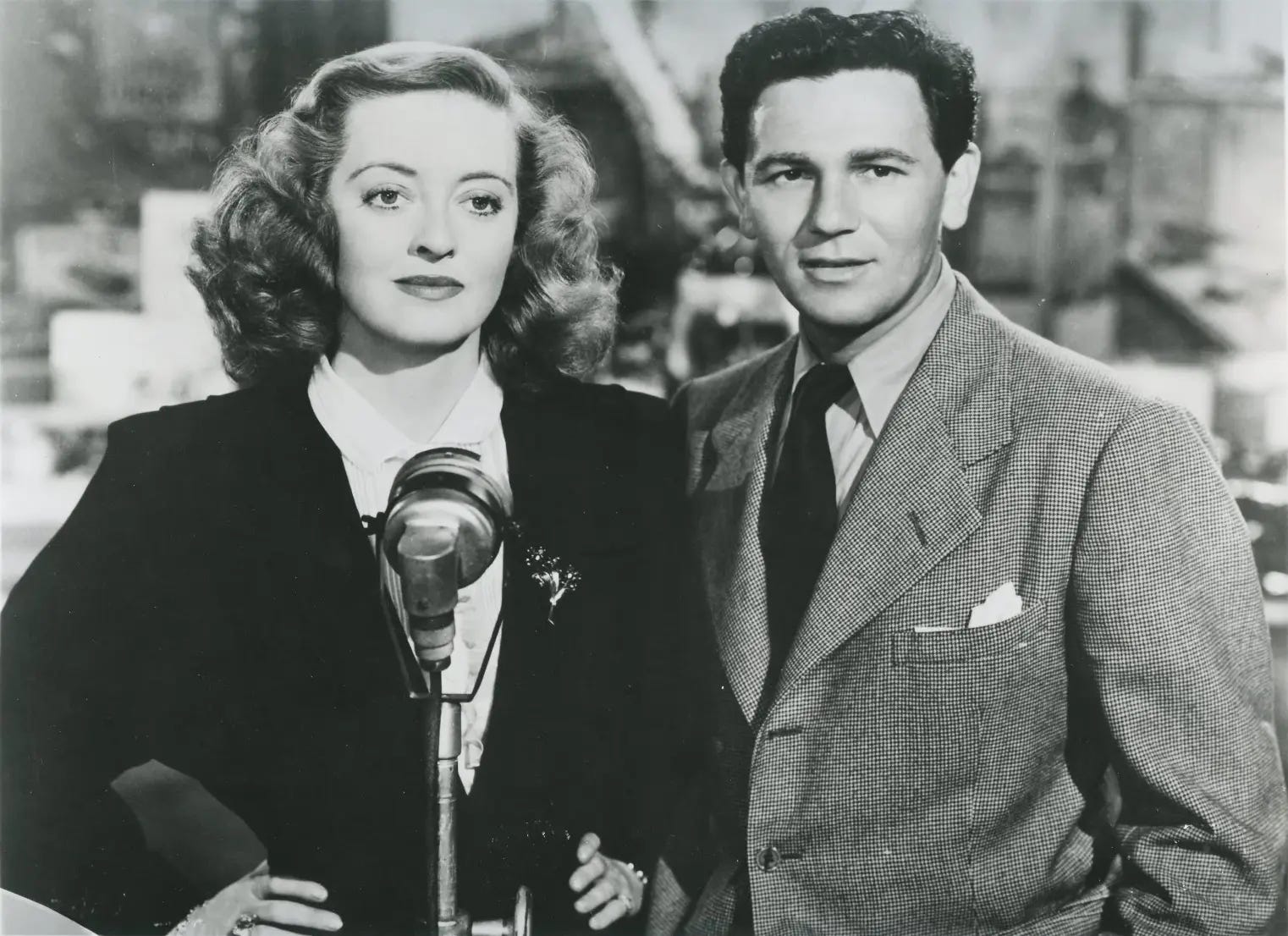
Hollywood Canteen
Delmer Daves, 1944
Rating: BB
Cast: The Andrews Sisters, Jack Benny, Joe E. Brown, Eddie Cantor, Kitty Carlisle, Jack Carson, Joan Crawford, Faye Emerson, Sydney Greenstreet, Alan Hale Sr., Paul Henreid, Joan Leslie, Peter Lorre, Ida Lupino, Dorothy Malone, Dennis Morgan, Janis Paige, Eleanor Parker, Roy Rogers (with Trigger), S.Z. Sakall, Zachary Scott, Alexis Smith, Barbara Stanwyck, Jane Wyman, Jimmy Dorsey
The film takes place in the actual Hollywood canteen, a real nightclub started in the forties by cinema stars and directors (Bette Davis and John Garfield being the two key founders) where servicemen taking leave in Los Angeles could have a place where they’d be honored for their efforts and served drinks by their favourite movie stars (it’s also where Gene Tierney contracted the disease that would inspire Agatha Christie’s The Mirror Crack’d). The war department saw it as a great opportunity to get more soldiers to join the ranks, so a moral-boosting propaganda film was commissioned, its plot involving a dopey soldier (Robert Hutton) who gets the chance to take his favourite actress (Joan Leslie as herself) out for a date: you’ll laugh your head off when you see a movie star hanging out in her backyard, asking her date to keep his voice down in order that her parents won’t be wakened by the sound—what movie star ever actually came from Los Angeles? The parade of famous faces (including Crawford) is a delightful sight, but the informercial-style dialogue will have you screaming: “Hey, you’re Mrs. Skeffington! I saw your latest movie” (looks dead straight at camera) “We see films on the ship before they get screened for regular audiences!”
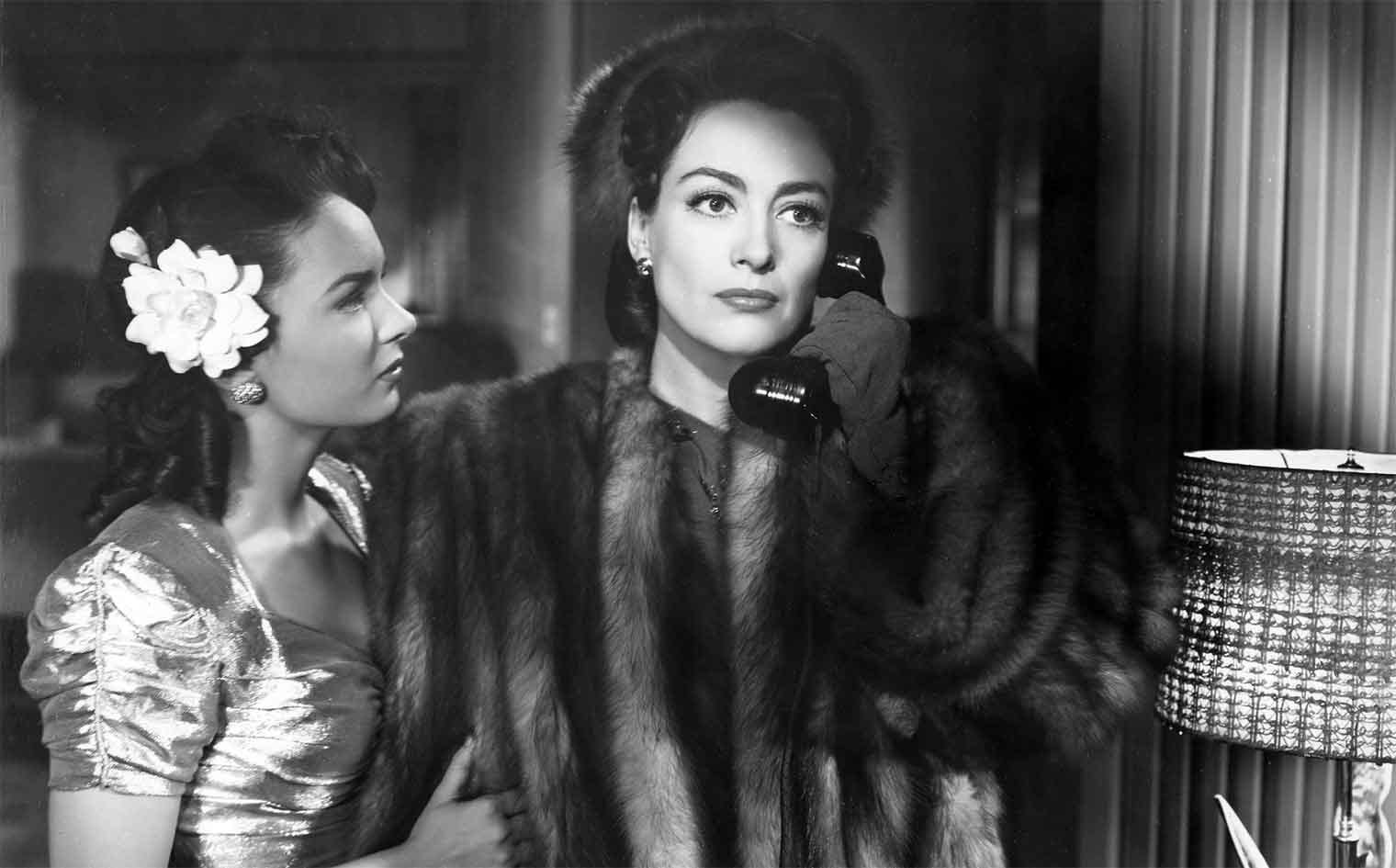
Mildred Pierce
Michael Curtiz, 1945
Rating: BBBBB
Cast: Joan Crawford, Jack Carson, Zachary Scott, Eve Arden, Ann Blyth, Bruce Bennett, Lee Patrick, Moroni Olsen, Veda Ann Borg, Jo Ann Marlowe, Butterfly McQueen, John Compton, Charles Trowbridge, Garry Owen
Famously known as one of the greatest career comebacks of all time, but I don’t know how you couldn’t be impressed by this film and performance even if you knew nothing about Joan Crawford or her career before you saw it. This classic film noir is about an ambitious single mother (Crawford) who claws her way out of poverty and into a successful business only to succumb to the wandering ways of her selfish, unappreciative daughter (Ann Blyth). She worries about her child becoming spoiled and selfish, but her only method of appealing to her daughter’s approval is to give her everything and then give her more, her blind spot likely the result of her own desire to make up for what she missed out on in life. Crawford, whose career had foundered at MGM and debuted her brand new Warner Bros. contract with this enduring classic (which earned her an Oscar to boot), gives an unshakeable performance that keeps you on the character’s side despite her many moments of weakness for a child who looks down on the fried chicken and pies that have turned her into a wealthy woman. Curtiz adds a criminal act to James M. Cain’s 1941 novel as a way to bring the story into the style of noir films that were popular in the era and does so without misdirecting the story’s aims (the more recent, superb miniseries starring Kate Winslet directed by Todd Haynes proves this to be true). Gorgeously photographed and endlessly rewatchable, this is one of the finest films of the decade.
I recorded an episode of my podcast “My Criterions” about this movie and got a lot of great feedback from fellow children of workers in the food industry. Take a listen here:
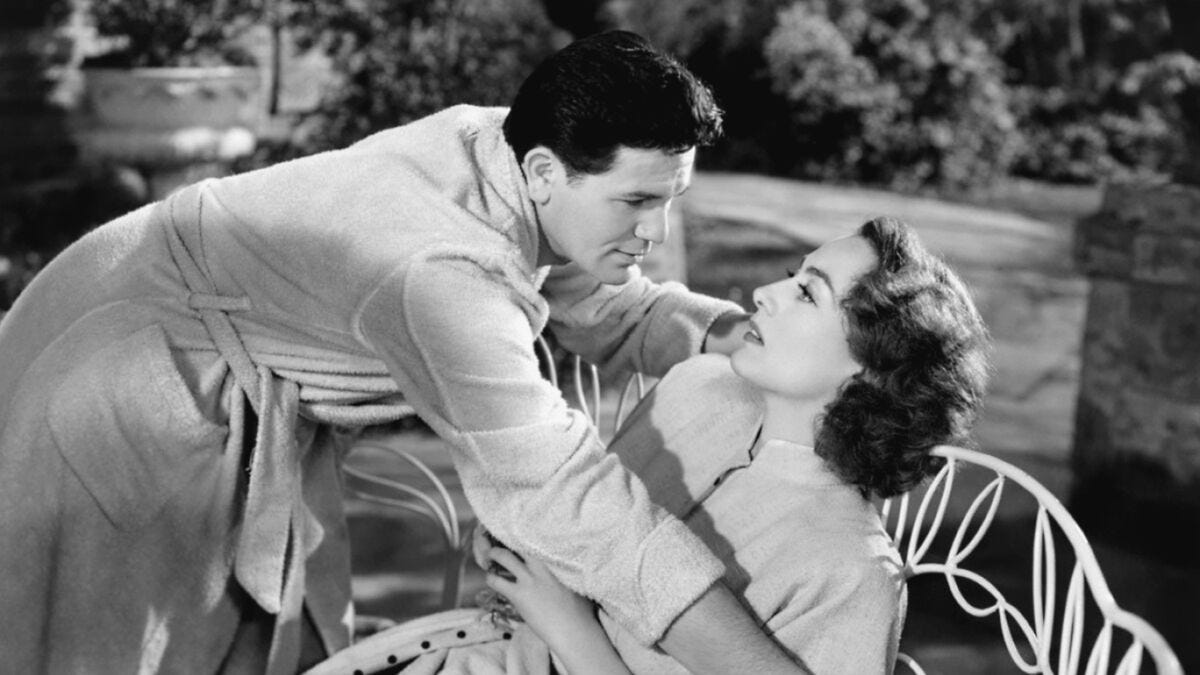
Humoresque
Jean Negulesco, 1946
Rating: BBBB
Cast: Joan Crawford, John Garfield, Oscar Levant, J. Carrol Naish, Joan Chandler, Tom D’Andrea, Peggy Knudsen, Ruth Nelson, Craig Stevens, Paul Cavanagh, Richard Gaines, John Abbott, Robert Blake, Tommy Cook, Don McGuire
John Garfield is a famous violinist who has just dropped out of a major performance, sitting alone and despondent in his mansion. He flashes back to the life that brought him to this place, first as a poor kid in New York City whose mother encourages his desire to play the violin despite his grocer father’s protestations, through to his awkward early years establishing himself, studying at a national music institute while practicing for hours on end at home. A friend brings him to a society party where he feels out of his element until fixing eyes on a wealthy, alcoholic Joan Crawford, who keeps her cuckolded husband on one side and her latest boy toy on the other. She takes an interest in Garfield’s talent and becomes his patroness, then toys with him sexually until she realizes that he isn’t just another lover to use and toss away. His dangerous obsession with her, which sees him throw away his devoted girlfriend and go against the wishes of his mother, threatens to get in the way of his career, while her love for him puts her own corrupt marriage and addiction into sharper focus. So shamelessly melodramatic a plot should be painful to sit through, it sounds downright trashy in description, but Negulesco takes the stakes of the world of soap opera seriously and gives them style, heart and glamour, getting a world-class performance out of Crawford as a woman who long ago forgot that she could ever pull herself out of so miserable a life, and Garfield as a man who loves his art as much as he loves the chip on his shoulder. It’s deeply involving from beginning to end, graced with an exceptional performance by Ruth Nelson as Garfield’s mother, who never allows the character to fall into twee caricature but presents a grounded, opposing force to all this drippy, breathless romance and helps deliver us a full-bodied, three dimensional movie. Gorgeously photographed (its images inspired Madonna’s The Power of Goodbye video) and, naturally, features a terrific musical score.
Daisy Kenyon (Otto Preminger, 1947)
Possessed
Curtis Bernhardt, 1947
Rating: BBB
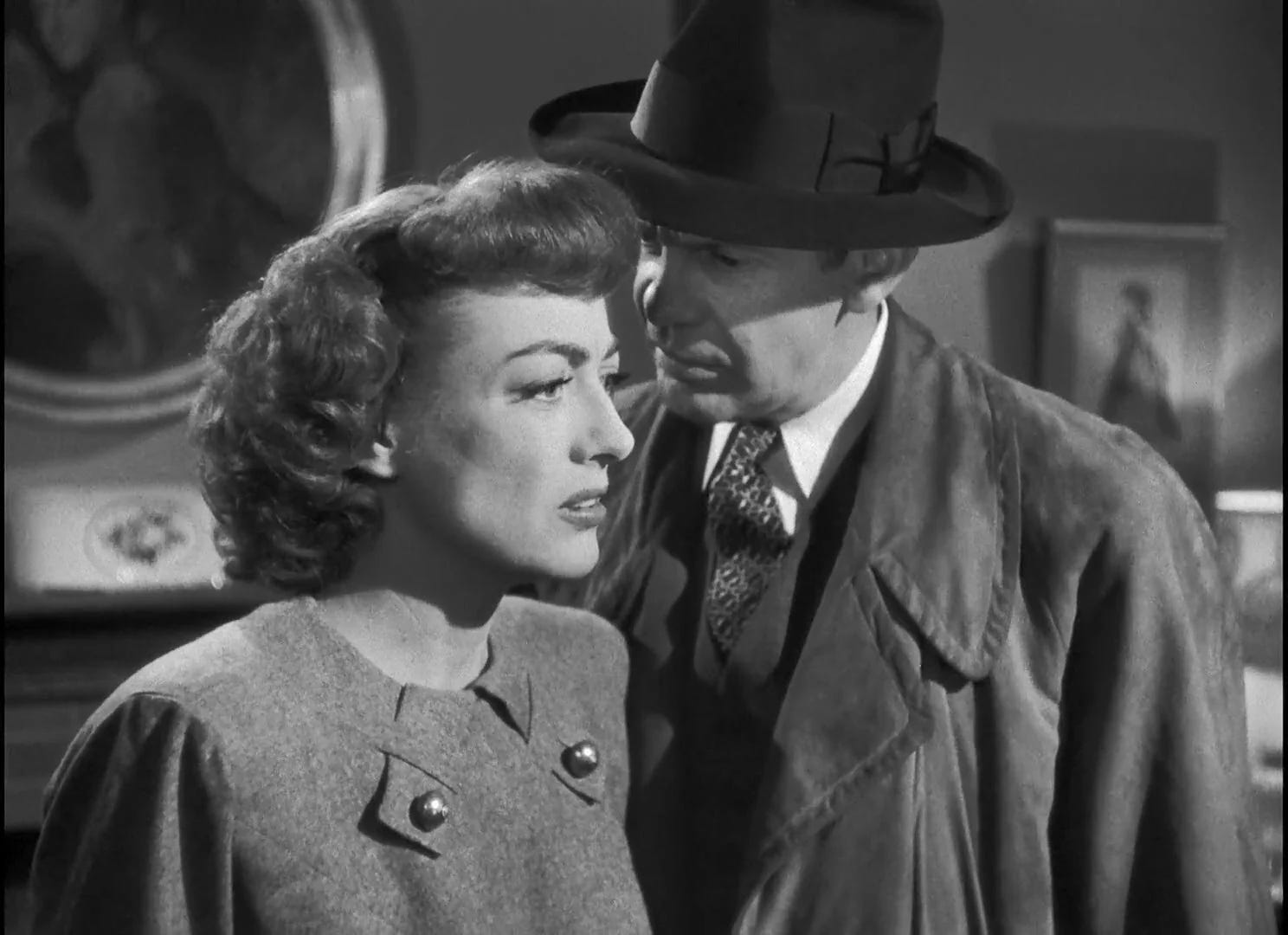
Cast: Joan Crawford, Van Heflin, Raymond Massey, Geraldine Brooks, Stanley Ridges, John Ridgely, Moroni Olsen, Erskine Sanford, Peter Miles, Jakob Gimpel, Isabel Withers, Lisa Golm, Douglas Kennedy, Monte Blue, Don McGuire, Rory Mallinson, Clifton Young, Griff Barnett, Nana Bryant
Crawford is madly in love with architect Van Heflin, but he’s had his fun with her and doesn’t want to get married. She is devastated and goes back to her job as nurse to a mentally ill woman, then when that woman dies she marries the grieving widower (Raymond Massey) to make Heflin jealous. All this really does is increase her own instability, especially when Heflin’s fear of monogamy is cured by Crawford’s gorgeous stepdaughter. This attempt to recapture the glory of Mildred Pierce is only successful in that Crawford is once again excellent in the lead, but the technical perfection of the cinematography adds to the cold and clinical feel that director Bernhardt has for Crawford’s character. The obsession of such a complex and lively woman over this dapper but mostly dull man is never easy to understand (it’s not like she was rejected by Joel McCrea), and while seeming to want to explore the psyche of a disappointed and mistreated woman in the vein of Leave Her To Heaven, the film’s more ridiculous plot twists (and an out of place dream sequence) eventually make it a foolish treatise on old world notions of female hysteria. Crawford earned her second Oscar nomination for her performance.
Flamingo Road (Michael Curtiz, 1949)
It’s A Great Feeling
David Butler, 1949
Rating: BB.5
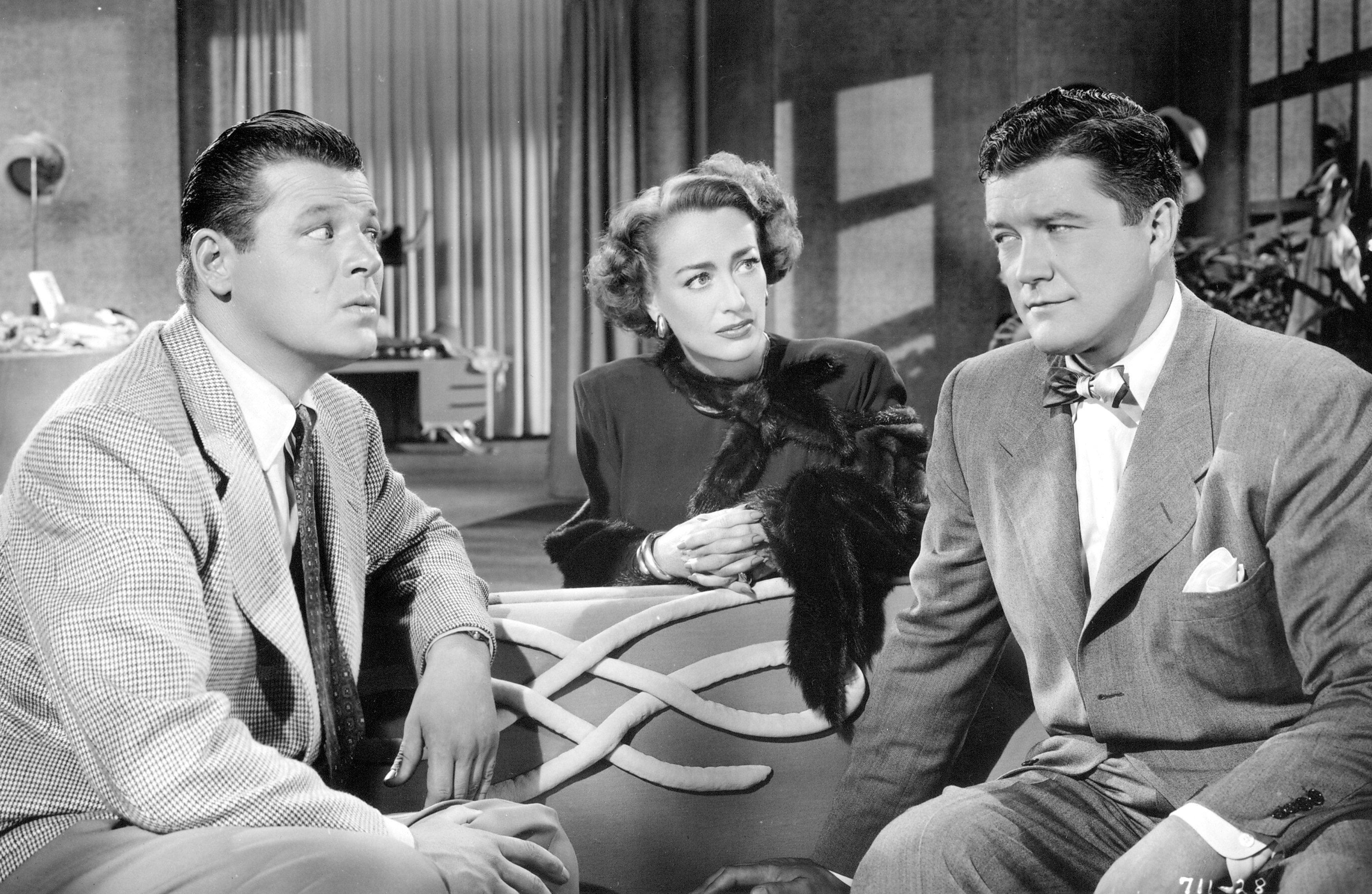
Cast: Dennis Morgan, Doris Day, Jack Carson, Bill Goodwin, Irving Bacon, Claire Carleton, The Famous Mazzone-Abbott DancersErrol Flynn, Lois Austin, Frank Cady, Pat Flaherty, Sandra Gould, James Holden, William J. O’Brien, Georges Renavent, Olan Soule, Nita Talbot
Dennis Morgan and Jack Carson play fictional versions of themselves, two bickering movie stars who are trying to get their latest film project off the ground except for one major hitch: no actress will work with Carson because he’s such a womanizer and a ham. Doris Day’s cheerful singing is all you need to get through this semi-musical, in which a host of Warner Bros. stars and directors make cameo appearances, the best of them Joan Crawford doing a wickedly funny impersonation of her dramatic self.