
My Week In Film: December 15, 2025
Sound of Falling, Nuremberg, Hedda, Belén, Close Your Eyes, Hell of A Summer, The Man From Laramie, Yellow Submarine
I’m still managing to watch a classic here and there (including, this week, finally seeing a cult favourite for the first time), but for the most part and, thanks to the generosity of studios who have sent me screeners, it’s gonna be a lot of awards season contenders for the next couple of months. This week, I catch up with Russell Crowe’s attempt at a comeback, see an updated vision of a theatrical classic and enjoy a prize winner from last spring’s Cannes film festival…plus more!
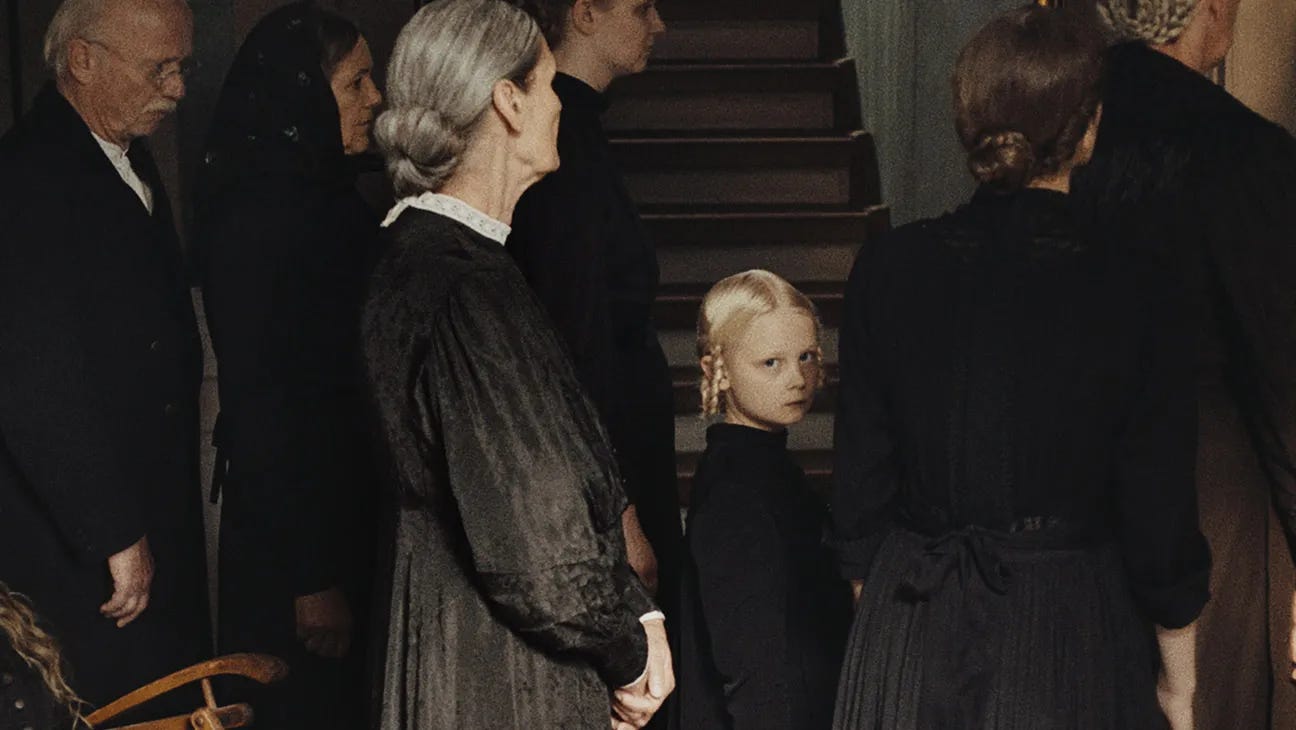
Sound of Falling
In Die Sonne Schauen
Mascha Schilinski, 2025
Rating: BBBB
Cast: Hanna Heckt, Lena Urzendowsky, Laeni Geiseler, Susanne Wuest, Luise Heyer, Lea Drinda, Florian Geißelmann, Greta Krämer, Claudia Geisler-Bading, Zoë Baier, Konstantin Lindhorst, Luzia Oppermann, Gode Benedix, Filip Schnack, Martin Rother, Andreas Anke, Liane Düsterhöft, Lucas Prisor, Ninel Geiger, Helena Lüer, Anastasia Cherepakha, Bärbel Schwarz
A farm in Altmark, Germany is seen in four different eras: a White Ribbon-ish pre-World War I, the end of the second World War, the depths of early-eighties GDR and the early twenty-first century. The earliest period sees a family go to extreme lengths to avoid their son being enlisted in the Great War, and in the second a woman tries to escape the worst of her country’s splitting in two. The farm they live on rests on the river that later divides East and West Germany and we see a young woman living only a few metres away from an alternate universe while enduring sexual abuse from her uncle. Moving forward to the present, a family moves into the property and meet their neighbours, everyone living in a freer and more empowered world, but are they? Schilinski holds to this one place throughout a century and shocks and entrances the viewer with a variety of characters and plots that connect in the most delicate of ways.
The actual throughline of this evocative work is the examination of the lives of women and the traumas they are subjected to, which vary depending on politics and epoch, but are ever present: sexual assault, the burden of poor mental health, even sterilization are folded into plot points that are sometimes vague but never feel genuinely confusing. What really blows the mind is the strength with which Schilinski moves through each era without any overt signals, seemingly placing one era over the other like sketches on wax paper, capturing themes of the death of rural culture and its effect on cultural change without ever naming these goals outright. In the modern day scenes, the strictures and setbacks of women’s lives are, in theory, changed very much for the better, but are there are still traces of suffering that have survived through generations and haunt the place like ghosts. Schilinski never spoon-feeds either prescriptive ideology or narrative, creating a piece that behaves like a collage but is actually a clear narrative on an emotional map, a story to be taken in through aesthetic sensibility rather than intellectual comprehension. It’s a baffling film (as indicated by my highly pretentious review), not an easy one to digest, but one that lingers in your consciousness for a long time after watching it, and one whose richness will only be expanded through repeat viewings.
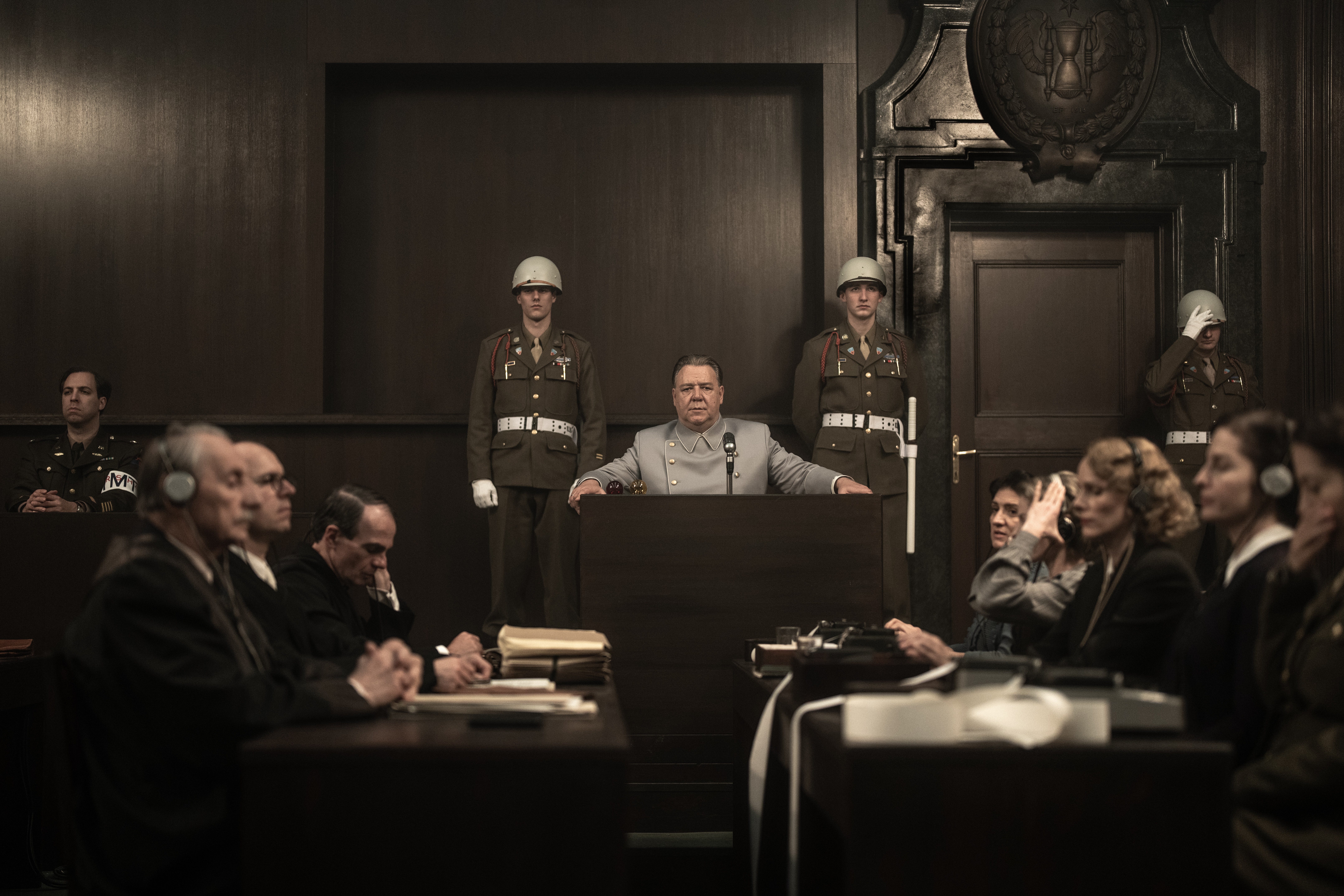
Nuremberg
James Vanderbilt, 2025
Rating: BBB
Cast: Russell Crowe, Rami Malek, Leo Woodall, John Slattery, Mark O’Brien, Colin Hanks, Wrenn Schmidt, Lydia Peckham, Michael Shannon, Richard E. Grant, Lotte Verbeek, Andreas Pietschmann, Steven Pacey, Paul Antony-Barber, Jeremy Wheeler, Wolfgang Cerny, Giuseppe Cederna, Dan Cade, Donald Sage Mackay, Dieter Riesle, Wayne Brett, Sam Newman, Philippe Jacq, Peter Jordan, Blake Kubena, Michael Sheldon, Fleur Bremmer
The war is over, Hitler has committed suicide and Germany has been defeated. The western world is reeling from the death toll while beginning to learn about the horrors of the Holocaust, Europe is rebuilding bombed out cities, and an American justice named Robert Jackson (Michael Shannon) has come up with a terrific way to put Germany’s second assault on world freedom to rest. Unprecedented in history, Jackson’s wants to place a series of high-ranking Nazi generals, who are currently in custody, on trial for their war crimes, held to account by a panel made up of justices from the four major Allied nations. It’s an event that is, today, thought of as a natural inevitability of the war but at the time was cause for concern for some of Jackson’s colleagues: allowing these villains to speak to the world could also mean letting them make a strong enough argument to come out looking either innocent or, at the very least, not guilty enough. The war department assigns a psychiatrist to attend the prisoners and assess their suitability for trial, a man named Douglas Kelley (Rami Malek), whose ultimate experience was the source of the book The Nazi and the Psychiatrist by Jack El-Hai, from which this film adapted its screenplay. Kelley forms a particularly interesting bond with star witness Hermann Göring (Russell Crowe), Supreme Commander of Hitler’s Air Force and the closest this event was going to get to condemning the big man himself. Calm, confident and insistent upon his innocence as someone who did what he was told and did not know the extent of his party’s atrocities, Göring doesn’t convince Kelley that he isn’t responsible for his part in Hitler’s genocide or military invasions, but Kelley is fascinated by him all the same, seeing a three-dimensional complexity that he believes is far more dangerous than what the public has turned into a cardboard black hat thanks to the fact that the right side has won. While the trial ends in glory for the free world, Kelley goes on to write a book that turns out to be something of a precursor to Hannah Arendt’s later treatise on the banality of evil, but his pointing out the danger of cults of personality and how easily American leaders could become just like Nazis is a much more dangerous suggestion in the Cold War Red Scare-paranoia years. The condemnation with which his opinions are greeted, and the failure of his book, lead to his own self-destructive behavior.
Vanderbilt’s prestige drama starts out strong and seems like it’s going to beat the odds it has going against its desire to be one of the most celebrated films of the year: there have already been many prize-laden films about World War II and we are well past the height of their popularity and quality (namely the nineties, after the success of Schindler’s List) and there is already a very famous film about this trial, Stanley Kramer’s Judgment At Nuremberg, that remains well known despite having been made over sixty years ago. Taking it from the perspective of Kelley’s character means giving the story an angle rarely considered in past movies about this war, and the tension between Malek’s Kelley and Crowe’s Göring (despite his bad German and rather overdetermined accent) is at first quite exciting. Once we pass the halfway mark, unfortunately, Vanderbilt’s script starts to fall apart, as Kelley begins to make errors in professionalism that the audience cannot sympathize with and from which he doesn’t seem to learn. The conclusion means to warn us that fascism never looks like fascism and history easily repeats itself, an appropriate message for the climate in which this film has been released, but it’s so poorly written that it comes off as having been made up on the spot. As an opportunity for Crowe to have his first admired and acclaimed performance in a very long time, the film is worth seeing, he brings a great deal of rascally charm to someone whose participation in one of humanity’s all-time greatest crimes is all the more evil the more we recognize his flesh and blood humanity. Malek is miscast as a Californian Irish-American, his twitchy facial expressions becoming more unreasonable the more we progress towards the end, and as a personality he always seems far too knowingly cynical to effectively pull off playing the rude awakening that results in so devastating a loss of his ideals. Leo Woodall fares much better as his translator, and although the film is very heavy on its masculine cast, Wrenn Schmidt manages a few superb moments as Jackson’s secretary.
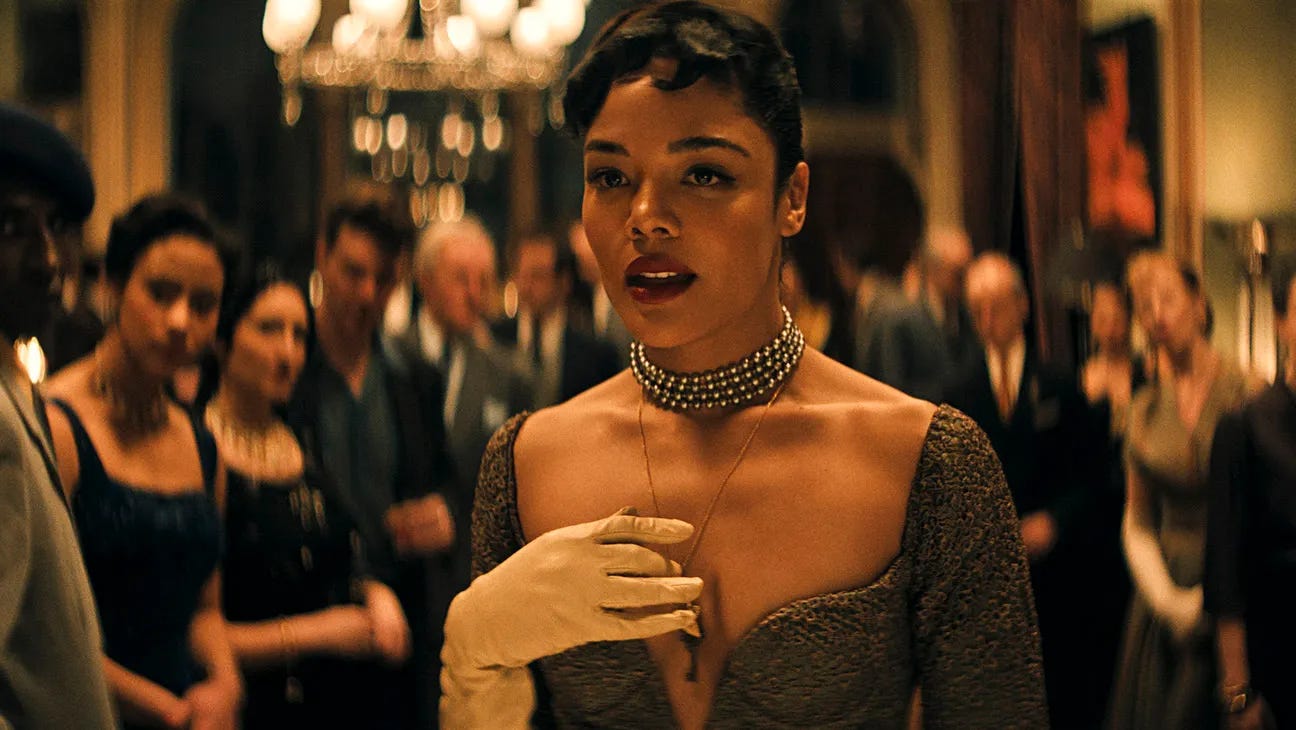
Hedda
Nia DaCosta, 2025
Rating: BBBB
Cast: Tessa Thompson, Nina Hoss, Imogen Poots, Tom Bateman, Nicholas Pinnock, Finbar Lynch, Mirren Mack, Jamael Westman, Saffron Hocking, Kathryn Hunter
You can land in just about any city on this planet and find a production of Miss Julie or A Doll’s House playing somewhere, Shakespeare is likely the only playwright performed with more regularity in the western world than the misery trilogy of Strindberg, Ibsen and Chekhov. Traditional adaptations of all their plays are easy to find on stage and screen, including Glenda Jackson’s Oscar-nominated performance in the very faithful 1975 film Hedda by Trevor Nunn, so you can clutch your pearls and be furious at this version’s alterations but it would be a petty thing to do, as things have been done the usual way a million times before now. It’s provocative of director DaCosta to decide that the original Ibsen play needs alterations to be deemed cinematic enough for today’s attention spans, but it’s a provocation that bears exciting fruit, as this highly altered interpretation of Hedda Gabler is very faithful to the spirit of the material while attacking its narrative from an alternate point of view.
Set in post-war England, it stars a glorious Tessa Thompson as the emotionally conflicted heroine who is about to throw a party with her frustrated academic husband George Tesman (Tom Bateman), an event that none of her guests realize is part of her plan to help his career and destroy that of a former lover. The party happens offstage in Ibsen’s play but becomes the focal setting of this version, attended by Thea Clifton (Imogen Poots), who has arrived ahead of her lover and colleague Eileen Lovberg (Nina Hoss, who was the male Ejlert Løvborg in the original) to celebrate their recent completion of a major investigative work, and confirm their ongoing personal and professional relationship. The book that Thea and Eileen have written is actually a threat to George’s possibly getting a very important appointment that will help his financial situation, as he is being pitted against Eileen for a professorship that means a great deal to him, but are Hedda’s machinations, which involve getting Eileen drunk and encouraging her to embarrass herself in front of everyone, all in the name of helping her partner, or does she have a more personal agenda in mind?
DaCosta is ambivalent about her anachronisms and confuses the viewer by not fully embracing them; that Hedda is a woman of colour is discussed in a film set during a time when her presence would have met with rejection from her husband’s social world, and homosexual relationships are treated as if they are de rigeur in a way that feels far too modern; I’m never entirely sure whether a decision has been made to create a fictional past or the real one was poorly researched (what I now call the Babylon conundrum). DaCosta does, however, keep things moving along from one scene to the next with an exciting fluidity that is pumped into high emotional gear by a series of exciting performances, with Thompson and Hoss naturally the most vibrant of them all; the hardest part about playing Hedda, if you’re good at it, is maintaining a sense of inner turmoil while seeming to behave in the most predictable way possible, and Thompson’s passionate and powerful eyes do a great deal of work while pulling off quiet smiles and polite hostess activities.
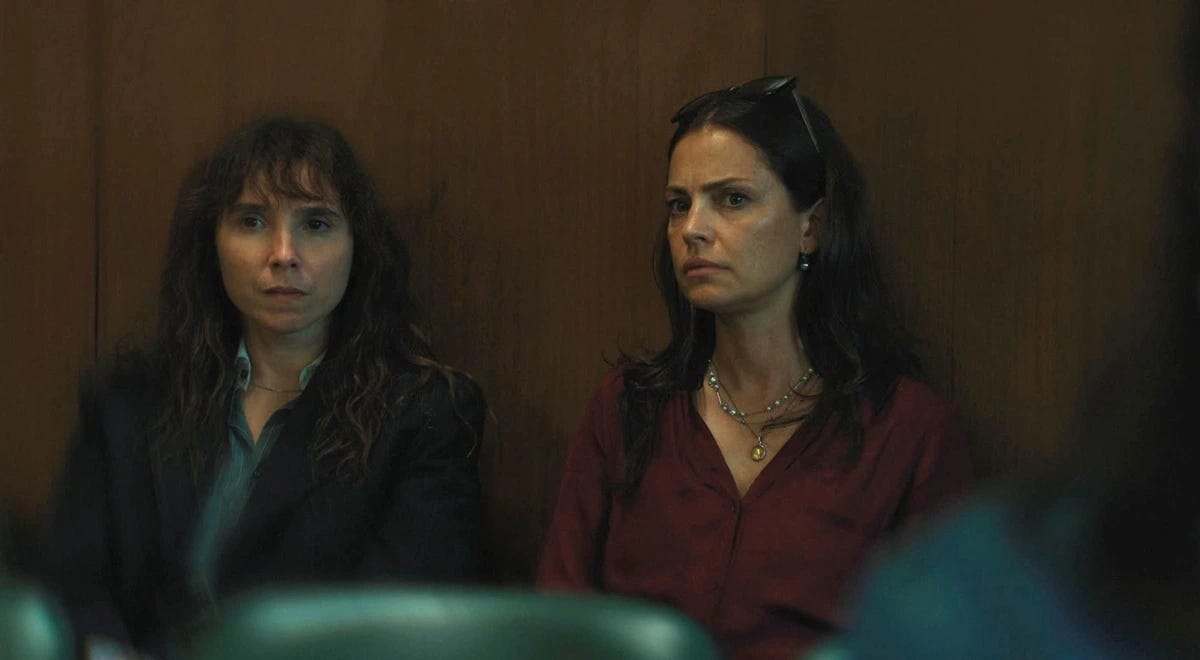
Belén
Dolores Fonzi, 2025
Rating: BBBB
Cast: Dolores Fonzi, Camila Pláate, César Troncoso, Julieta Cardinali, Luis Machín, Laura Paredes, Sergio Prina, Ruth Pláate, Lili Juarez
A landmark case in Argentinean law and the changes it affected for women’s rights in that country is the inspiration for a very enjoyable, if not in the least bit innovative, biopic. A young woman (Camila Pláate) checks into a Tucumán hospital with abdominal pains and, during her initial examination, goes to the bathroom; later, while doctors are treating her for a miscarriage, police burst into the operating room and arrest her for having an illegal abortion, showing her a fetus that they claim they recovered from the toilet she just used. She languishes in prison for two years, given no help by a magnificently incompetent public defender (a venomous characterization that, if it’s based on a specific person, could easily inspire a Lost King-style lawsuit) before a classy attorney named Soledad Deza (played by director Fonzi) decides to take on her case. Believing that public support will be instrumental in getting them over the finish line, Fonzi’s team give the accused a pseudonym, the very saintly-sounding Belén (it’s Spanish for Bethlehem) and make her a symbol for change. What Deza comes up against in looking to clear this woman of an unjust and, quite frankly, sloppily assembled accusation is a nightmare of bureaucratic runaround from a patriarchal judicial system not willing to admit its mistakes, and a religiously conservative society terrified of making room for (poor) women’s freedom to control their bodies and, therefore, their fate. If you’ve ever seen a politically-themed, fact-based drama, you’ll recognize every step of the process here, but while Fonzi hasn’t come up with something to equal the quality of Dirty War histories like The Official Story or Chronicle of An Escape, she does wisely embrace the cliches of the genre and finds the truth in all the characterizations on screen (including in her own wonderful performance). Based on the non-fiction book about the real case, Somos Belén by Ana Correa.

Close Your Eyes
Cerrar los ojos
Victor Erice, 2023
Rating: BBBBB
Cast: Manolo Solo, José Coronado, Ana Torrent, María León, Petra Martínez, Soledad Villamil, Antonio Dechent, Mario Pardo, Helena Miquel, José María Pou, Juan Margallo, Venecia Franco
Erice barely makes one feature film per decade and it’s always worth the wait. Besides being a master storyteller in his use of image and narrative, Erice could be labeled a sorcerer for his skill in weaving enchantment on celluloid, which he does in this exceptionally fine and, at three hours in length, too short film. It begins, deceptively, with an interview between an aging Jewish merchant, Monsieur Levy (Jose Maria Pou) and the detective (Jose Coronado) he has invited to his villa in a Paris suburb, the time period sometime in the late 1940s. Levy wants the private eye to travel to the far east and find the girl that he fathered with a Chinese woman, and bring her back to meet him before he dies. The scene ends, narration begins to speak over the soundtrack, and we realize that we’ve been watching a film within a film: the footage of the interview was from the few surviving fragments of a project called The Farewell Gaze, which director Miguel Garay (Manolo Solo) was working on with his longtime friend and collaborator Julio Arenas (the actor playing the detective) before the latter disappeared without a trace. It has been decades since the unfinished project was abandoned thanks to Arenas never resurfacing, and Garay, who has never returned to filmmaking and has gone back to his first love of writing, has been invited onto a television infotainment show to discuss the case. Having left his quiet life in a seaside town to spend time in the city for the interview, Garay also meets Arenas’s daughter (Ana Torrent, longtime collaborator of Erice going back to her debut in The Spirit of the Beehive in 1973) and reconnects with an old girlfriend after spotting a book he gave her at used book store. He returns home to his neighbours and friends in his peaceful hamlet, but a phone call comes in and things shift in a completely new direction.
The rest of the plot is for you to discover, I want you to have as magical an experience on this journey as I did, but it’s worth pointing out how little this film uses interpersonal conflicts to keep things going. The characters all ask things of each other that are always met with affirmative agreement, all possibilities are explored and generosity is never avoided; in deference to E.M. Forster’s directive, everyone connects, but love and care at its most powerful can do nothing about the fact that we will all, eventually, fade away. There are no enemies in this movie, but there is the cruelty of time, and the power of cinema to both preserve our memories and torture us with them. This film manages to leave you thinking about these things without putting you in a dark or heavy place, it’s a bewitching work by a master whose rare appearance on movie screens only make him seem that more of a mischievous and mysterious conjurer.
Hell Of A Summer
Finn Wolfhard, Billy Bryk, 2023
Rating: B.5
Cast: Fred Hechinger, Abby Quinn, D’Pharaoh Woon-A-Tai, Billy Bryk, Finn Wolfhard, Pardis Saremi, Rosebud Baker, Adam Pally, Susan Coyne, Krista Nazaire, Matthew Finlan, Daniel Gravelle, Julia Doyle, Julia Lalonde
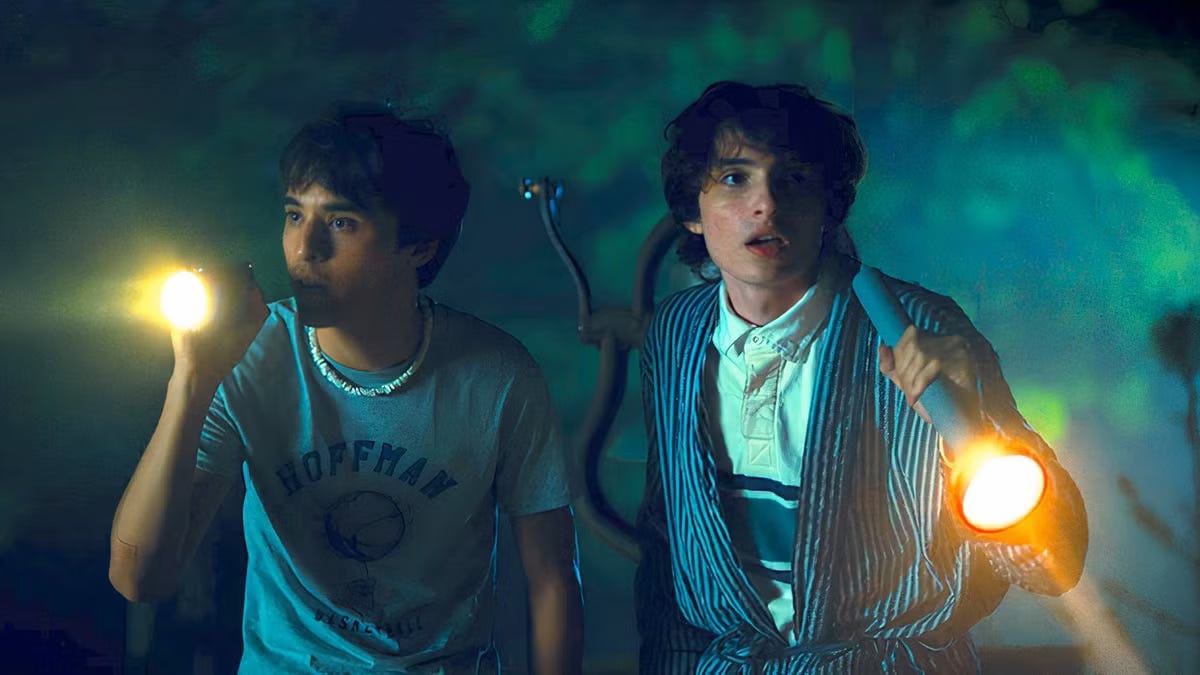
Oh good, another low-budget cabin in the woods movie. Actors Wolfhard and Bryk star in, write and direct this mind-numbing exercise in a genre already full of attempts to reinvigorate its clichés with self-referential humour, which are even more tired than the pure originals that preceded them. A camp at the beginning of summer has yet to be overrun with little kids, but the teenaged counselors have arrived for a fun first weekend that is also their opportunity to get the place set up. Jason (Fred Hechinger) has worked there for a few years and, being in his early twenties, is probably too old for the job, but has a devoted attachment to coming back that likely has to do with a fear of adulthood. His unpopularity with his colleagues doesn’t serve him well when people start turning up dead and the survivors think he’s the killer, meaning that he not only has to outwit whoever it is that is putting on a black robe and knifing his friends, but must also prove that he’s innocent in the affair.
Attempts at goofy humour are all awkwardly miscalculated in this woeful bore, there are jokes about young people and their social media-inspired obsessions with fame that feel disingenuous, as if the filmmakers haven’t decided just how much they want to bite the hand that feeds them. None of these characters have any genuine vulnerability, so watching them get harmed doesn’t provoke a visceral reaction, and Hechinger’s stock in trade as the well-meaning slob is itself so cliched by now that it’s hard to care about his coming out of either of his complications safely. The real reason to set a horror movie at a summer camp is to save money, you can use one location in diverse ways and you don’t have to pay for extras, and the worst of them have no style and because of this make you feel the budget in every frame. Initially screened at the 2023 Toronto International Film Festival, this film struggled to get a proper release until the spring of 2025.
The Man From Laramie
Anthony Mann, 1955
Rating: BBBB.5
Cast: James Stewart, Arthur Kennedy, Donald Crisp, Cathy O’Donnell, Alex Nicol, Aline MacMahon, Wallace Ford, Jack Elam, John War Eagle, James Millican, Gregg Barton, Boyd Stockman, Frank DeKova
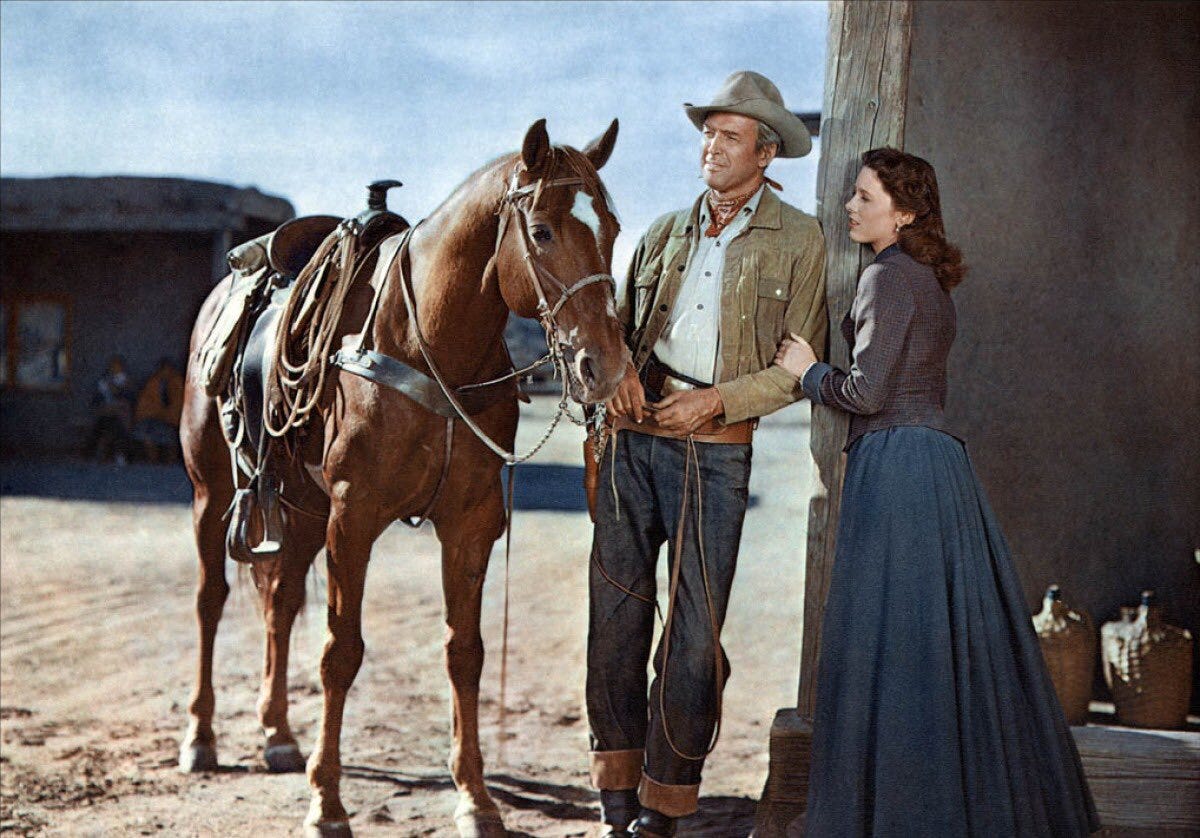
There’s just nothing like an Anthony Mann western, and this fifth and final collaboration between the director and James Stewart is among his best. The old Stranger Who Cleans Up This Town plot is put into great effect when Stewart shows up in Coronado to deliver supplies and is immediately made unwelcome. After unloading his goods, he asks if there is anything he can take back to Laramie and is invited to load up at the local salt flats; while doing so, the spoiled and stupid son of the local ranch-owning fatcat shows up and declares that the property is not open to all takers and promptly shoots Stewart’s mules. Now that he has a reason to stay, he does, but we learn that Stewart’s delivery job was actually a cover for his real mission, which was to find the man responsible for his little brother’s death during an ambush by Apache warriors, who were using rifles sold to them by someone in Coronado. His doing so causes divisions between the ranch owner (Donald Crisp), his son (Alex Nicol) and the rancher’s right-hand man and adopted son (Arthur Kennedy), who has long assumed that he would be inheriting the property upon the old man’s death.
Westerns took a turn from mythmaking to mythbusting in the fifties, John Ford’s The Searchers is the most obvious example, and the genre was the one most perfectly suited for expressing the concerns of Hollywood screenwriters who were being torn apart by Red Scare paranoia for having the audacity to investigate the wisdom of America’s unchecked post-war capitalist expansion. Greed, abuse of power and, in a roundabout and not particularly impressive way, the treatment of indigenous communities, are all packed into a plot that blazes with rage and excitement. Mann gives you the gorgeous, wide open spaces that you love from your favourite oaters but also fills the screen with so much tense emotion, and Stewart’s talent for projecting righteous fury with intense, quiet control gets you wrapped up in the story’s concerns from the get-go.
Yellow Submarine
George Dunning, 1968
Rating: BB
Cast: John Clive, Geoffrey Hughes, Peter Batten, Paul Angelis, Dick Emery, Lance Percival
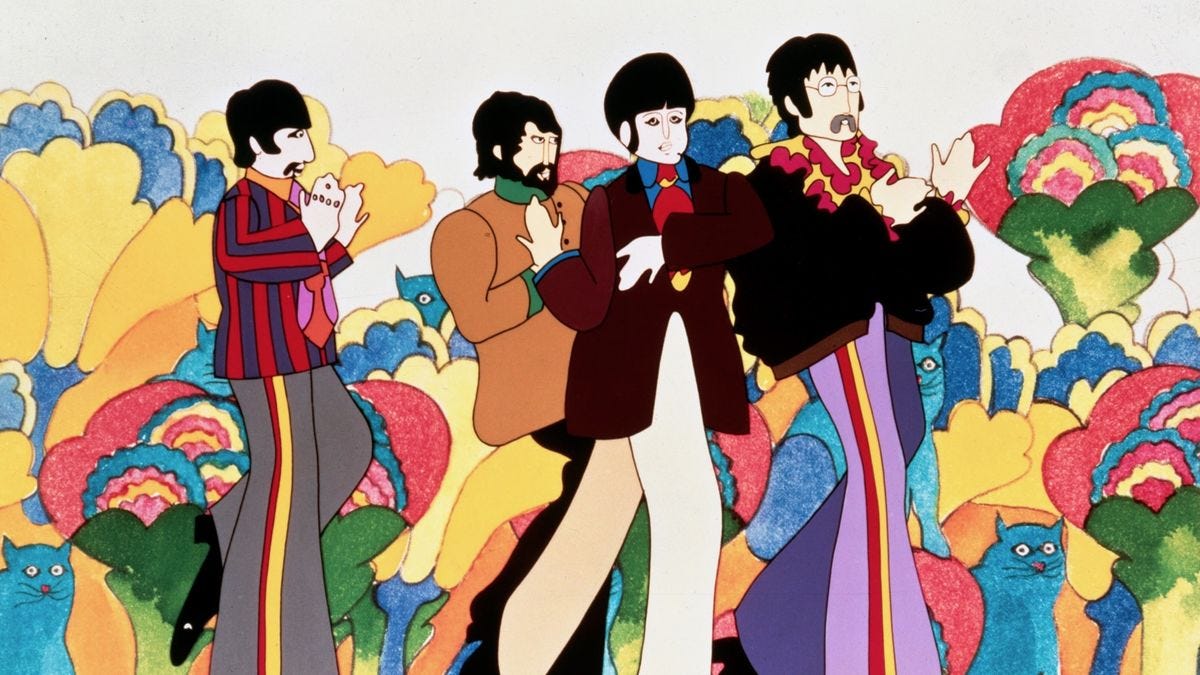
The Fab Four were near their full disintegration when this curiosity was released, a hastily produced bit of trippy animation that sets a number of their songs into a simple allegory of counterculture rebellion. We begin in the lovely meadows of Pepperland, a place whose citizens joyfully play music all the livelong day, until they are conquered by the Blue Meanies who turn anyone with a melody into stone. The Lord High Mayor enlists the help of “Young Fred” before being calcified himself, sending him in a yellow submarine to a far off land to find heroes to help their cause. Luckily, Young Fred finds John, Paul, George and Ringo, masters of music and men with a lot of free time, and brings them back to save the day, and just about every turn of phrase of this journey is an excuse for a musical number (among them the title song, “Lucy In The Sky With Diamonds” and many others).
The Beatles don’t do their actual speaking voices and are, instead, doubled by actors doing the kind of imitations of their accents that you and your friends usually perform at the end of a long, drunken party; they eventually appear in a live-action coda added to the end of the film only because they were eventually won over by the finished product, one that they initially resisted taking part in. The animation, colourful and impressionistic as it is, really is a time capsule of grooviness, drawn on a very fast schedule for the time and, to be generous, looks intentionally amateurish. Members of the Flower Generation embraced this film as a cult favourite and it’s not hard to see why, the songs are terrific and the silly excuses to include them in the plot are easy to forgive, but as someone who finally saw this in my middle age without having been there when it all happened, it’s a pretty flat experience.